
MegaETH Draws a Line on Exchange Listings
Ethereum Layer 2 project MegaETH announced that it will not provide MEGA tokens as incentives, fees, or airdrops to centralized or decentralized exchanges in exchange for listings. The statement, shared publicly by members of the MegaETH team on January 31, 2026, emphasizes that any future listings should be based solely on the project’s technical merits, adoption, and long-term value.
The move comes amid growing scrutiny of exchange listing practices, where projects are often expected to allocate significant portions of token supply or capital as a condition for market access.
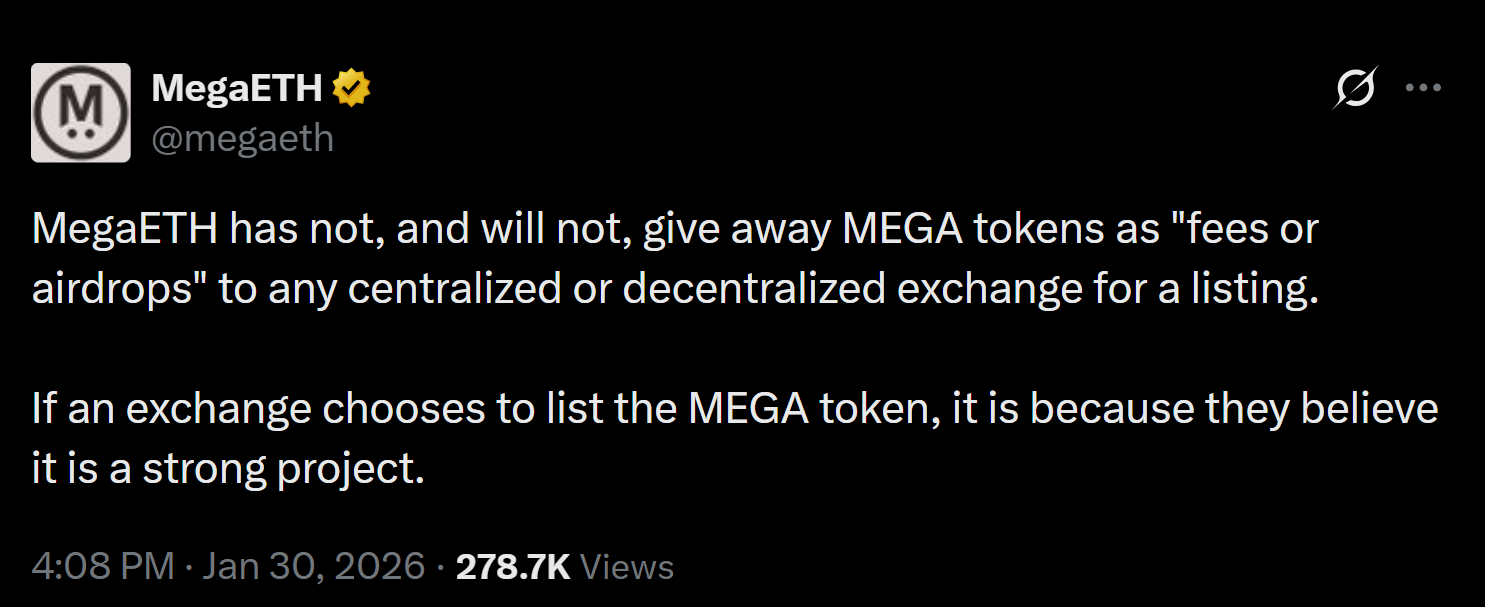
MegaETH’s official X post (screenshot) stating it will not pay token incentives or airdrops for exchange listings.
What Is MegaETH?
MegaETH is a high-performance Ethereum Layer 2 network designed for real-time transaction execution. The project targets ultra-high throughput, sub-millisecond latency, and full EVM compatibility, positioning itself for use cases such as high-frequency DeFi trading, on-chain gaming, and interactive decentralized applications.
The network architecture relies on techniques such as node specialization and in-memory state management while inheriting Ethereum’s security guarantees. MegaETH has reported successful stress testing at tens of thousands of transactions per second and is scheduled to launch its mainnet in early February 2026.
Token Model and Milestone-Based Unlocks
MegaETH’s tokenomics reflect its broader stance on incentive alignment. Of the network’s total token supply, a majority is locked behind predefined milestones tied to network usage, decentralization progress, and performance benchmarks. Tokens unlock only if these conditions are met, with governance mechanisms expected to play a role if targets are missed.
By avoiding discretionary distributions tied to exchange access, the team aims to reduce sell pressure and ensure that token supply expansion corresponds to measurable ecosystem growth.
A Contrast to Paid Listing Models
The announcement implicitly contrasts MegaETH’s approach with incentive-driven listing programs that have drawn criticism across the industry. In recent years, some centralized exchange initiatives have been accused of favoring short-term volume generation over sustainable project development, often resulting in post-listing volatility and retail losses.
Against this backdrop, MegaETH’s refusal to participate in pay-to-list dynamics positions it as an outlier among high-profile launches — prioritizing organic demand over immediate liquidity.
Centralized Listings vs Permissionless Launches
MegaETH’s announcement highlights a growing structural divide between centralized exchange listings and permissionless DeFi launch paths. While both offer liquidity and visibility, their incentive models differ fundamentally.
Listing Model Comparison
| Dimension | Centralized Exchange Listings | Permissionless DeFi Launches |
|---|---|---|
| Access Control | Exchange-approved, negotiated | Open, on-chain participation |
| Token Incentives | Often required (allocations, airdrops, fees) | None required |
| Price Discovery | Influenced by listing mechanics | Market-driven via liquidity curves |
| Distribution | Skewed toward early insiders | Broad, transparent participation |
| Sell Pressure Risk | High post-listing | Gradual, organic |
| Governance Alignment | Off-chain, opaque | On-chain, auditable |
| Retail Outcomes | Frequently volatile | Generally more predictable |
Taken together, MegaETH’s refusal to offer token incentives highlights a growing pushback against extractive listing practices that prioritize short-term liquidity over long-term network health. As more projects explore permissionless launch paths and milestone-based unlocks, the contrast between centralized gatekeeping and decentralized distribution models is becoming harder to ignore. Whether this approach proves sustainable at scale will depend less on exchange access and more on real usage, developer adoption, and on-chain demand.