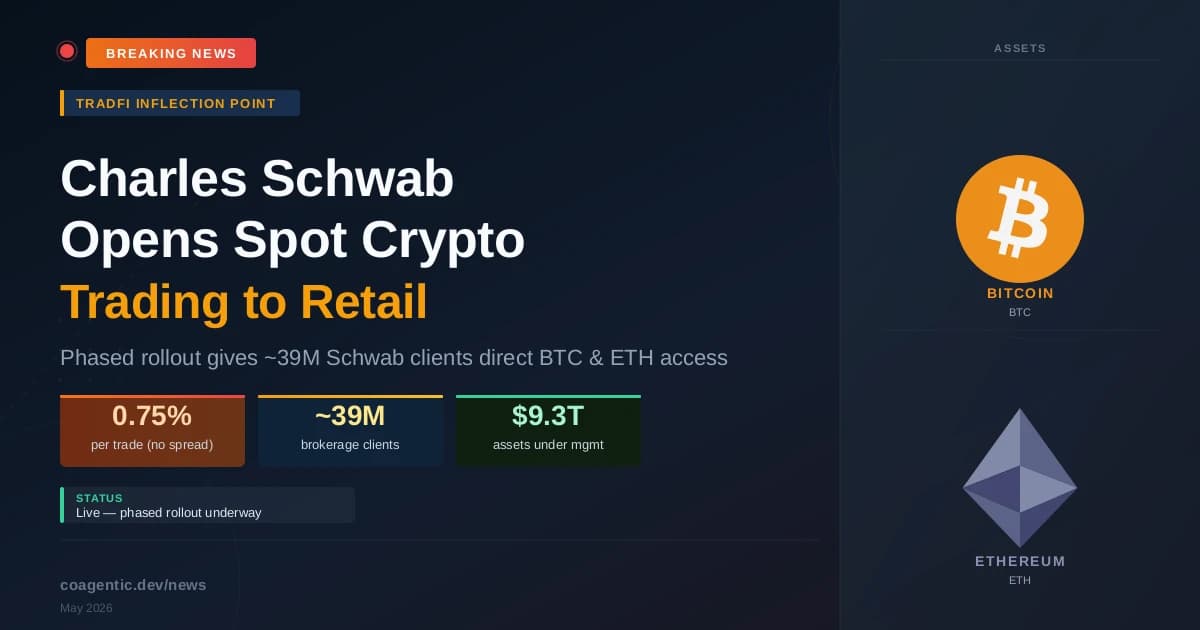
Charles Schwab has begun rolling out direct spot crypto trading to retail clients, marking one of the most significant TradFi-to-digital-assets crossovers to date.
At the end of March 2026, the firm reported $11.77 trillion in client assets and 39.1 million active brokerage accounts — a distribution footprint that no crypto-native exchange comes close to matching. The product, called Schwab Crypto™, has been made available to the first wave of eligible retail clients, charging a 75-basis-point fee per trade and available in most U.S. states, excluding New York and Louisiana.
What Schwab Crypto Is
Schwab Crypto is a spot crypto trading offer beginning a phased rollout to retail clients, providing direct access to bitcoin and ethereum trading, combined with educational content and experienced professional support.
The key design decision is integration, not isolation.
Clients can view and trade cryptocurrency and traditional investments side-by-side across Schwab.com, Schwab Mobile, and thinkorswim®, Schwab's award-winning trading platform. For clients who already hold stocks, ETFs, and bonds at Schwab, bitcoin and ether will appear as another line item — no new app, no new login, no second account.
Schwab says clients will use separate crypto accounts, with Charles Schwab Premier Bank as primary custodian and Paxos handling execution and sub-custody.
Paxos, the regulated trust company, already holds a federal banking charter from the Office of the Comptroller of the Currency.
The official framing from Jonathan Craig, Head of Retail Investing at Charles Schwab: "We know our clients want to conduct more of their financial lives at Schwab. With Schwab Crypto, clients who want direct access to the asset class can trade it alongside their other investments, while benefiting from the service, education, and research they expect from us."
Product Details at a Glance
| Feature | Detail |
|---|---|
| Assets at launch | Bitcoin (BTC) and Ethereum (ETH) |
| Trading fee | 0.75% per trade (75 basis points) |
| Holding fee | None |
| Primary custodian | Charles Schwab Premier Bank, SSB |
| Sub-custody and execution | Paxos (OCC federal bank charter) |
| Platform access | Schwab.com, Schwab Mobile, thinkorswim® |
| Geographic exclusions | New York, Louisiana, and U.S. territories |
| Self-custody / withdrawals | Not available at launch |
| Insurance | Not FDIC or SIPC insured |
| Rollout model | Phased — early access cohort first |
Phased Rollout and What's Next
Schwab has begun a phased launch starting in Q2 2026. An initial cohort of employees and early-access registrants will trade first before the platform opens to the firm's broader client base. Clients who registered on the Schwab Crypto waitlist are being admitted in waves.
Schwab has said it intends to expand beyond Bitcoin and Ethereum and add transfer capability over time. No timeline or specific assets have been confirmed for the next phase.
The Demand Was Already There
The launch is notable partly because of what preceded it.
Charles Schwab's clients hold about 20% of US spot crypto exchange-traded products — demand is already concentrated inside Schwab's franchise, and every trade those clients execute on Coinbase or Robinhood is revenue and behavioral data leaving the brokerage.
The phased launch expands beyond the firm's prior ETF and derivatives-only crypto exposure. Previously, Schwab clients could access crypto via ETPs, futures, options on spot ETPs, and thematic ETFs — none of which involved direct ownership of BTC or ETH.
Competitive Context
Schwab's entry sharpens an already competitive market — and Schwab does not hold the low-cost position.
Morgan Stanley launched spot crypto trading on ETrade on May 6, a week before Schwab's rollout began, at 50 basis points — 25 bps below Schwab. Fidelity Crypto charges 100 bps. Coinbase's retail fees can reach 4%. At 75 bps, Schwab sits between Fidelity and Morgan Stanley ETrade, and above Robinhood's lower end.
The broader institutional move is accelerating.
Standard Chartered launched institutional spot Bitcoin and Ethereum trading in July 2025, Goldman Sachs filed for its first Bitcoin ETF in April 2026, JPMorgan started exploring institutional crypto trading in December 2025, and Fidelity received OCC approval in February 2026 for bank-based crypto custody and execution.
Morgan Stanley's ETrade pilot also launches with BTC, ETH, and SOL — one asset broader than Schwab — using Zerohash for custody and execution, and targeting all 8.6 million ETrade customers by the end of 2026. The firm framed the move as "disintermediating the disintermediators."
Robinhood built a large part of its identity around easy access to trading, including crypto, for retail investors. With both Schwab and Morgan Stanley E*Trade now entering direct spot crypto, Robinhood faces well-resourced rivals competing for the same retail crypto users — and on price, it no longer holds an obvious advantage.
Regulatory Tailwinds
The timing of the Schwab launch is not accidental.
The SEC rescinded Staff Accounting Bulletin 121 in January 2025, removing the requirement for custodians to record client crypto as balance-sheet liabilities.
The FDIC rescinded its prior-approval requirement for permissible crypto activities in March 2025, while the OCC clarified in May 2025 that national banks may buy and sell customer-custodied crypto and outsource execution with proper risk management. Those three regulatory shifts together removed the principal structural barriers that had kept large brokerages on the sidelines.
What It Means
Schwab's launch does not change the mechanics of Bitcoin or Ethereum. It changes who can access them without friction — and that is the relevant data point here.
Millions of Schwab customers currently hold traditional assets and use external exchanges for crypto. Bringing those functions under one account reduces friction and strengthens Schwab's footprint across asset classes.
The limitations are real and worth tracking: no self-custody, no on-chain withdrawals, no FDIC or SIPC coverage, and geographic exclusions at launch.
Whether Schwab's conservative pricing and trusted brand can draw crypto volume away from lower-cost platforms with broader token selection remains the central question heading into the second half of 2026.
Early adoption signals, exec commentary post-launch, and any regulatory response are being tracked. This article will be updated as that data emerges.