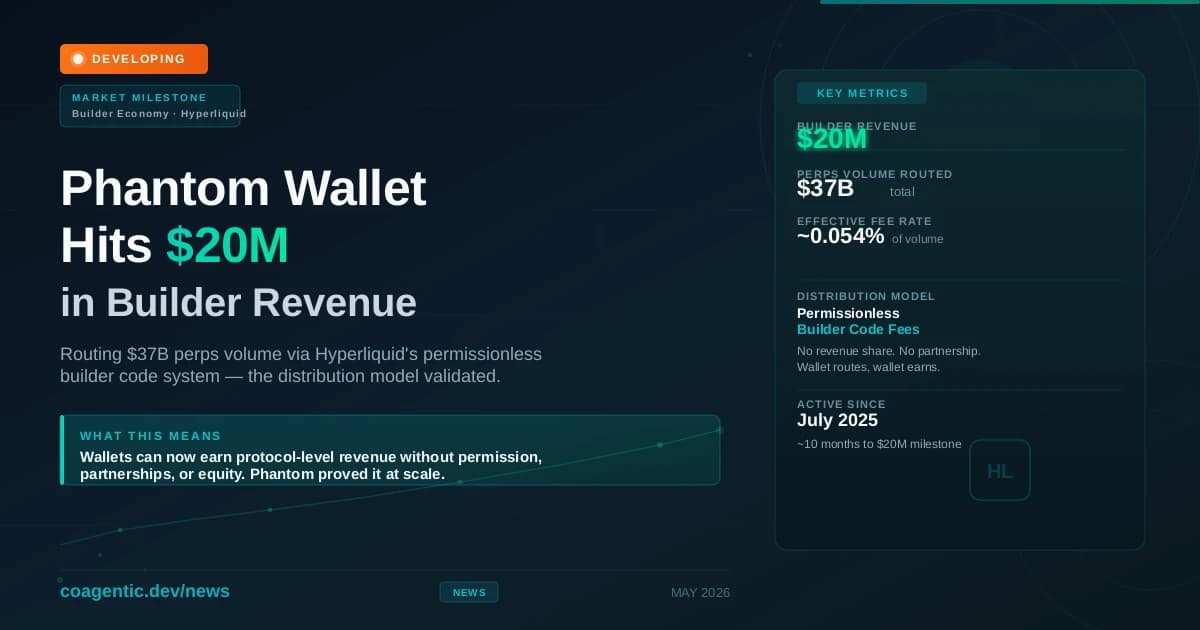
On May 12, 2026, Hyperliquid confirmed what the April 14 analysis of the builder model argued was coming: permissionless distribution works at scale.
Hyperliquid officially congratulated Phantom on reaching $20M in builder code revenue in under a year. The wallet did it without launching a token, without building a matching engine, and without negotiating a single CEX listing. It just built a good product and attached a builder code.
This is the thesis as a data point, not a theory.
What the Numbers Actually Mean
Phantom earned the $20M figure in builder code fees since launching the Hyperliquid partnership in July 2025, processing $37 billion in trading volume along the way. At that volume, $20M in fees on $37B in volume means the wallet is capturing roughly 5.4 basis points per dollar traded. That fee rate, applied consistently across ~134,000 active Phantom users on the platform (averaging $149 each in volume), compounds into a meaningful revenue line — from a single integration.
Phantom is the headline, but the broader ecosystem picture is more instructive. Total builder code revenue across all teams has now exceeded $45M, according to on-chain tracking data shared by xulian.hl on X prior to the Phantom milestone.
Hyperliquid's third-party ecosystem has reached an annualized revenue run-rate of over $100 million , according to analyst Ryan Watkins.
Over 100 teams have now integrated via builder codes, each earning a share of fees.
The builder type diversity matters as much as the headline numbers.
PVP.trade has generated $7.2 million in lifetime revenue — a social copy-trading platform, not a wallet. Based has accumulated roughly $11M through a different distribution model again.
The builder code ecosystem spans trading terminals, copy-trade bots, wallet integrations, and analytics dashboards — each capturing a share of the value they create by tagging trades with their builder address. This is not a winner-take-all structure. It is a fragmented, specialised distribution layer.
HYPE pulled back sharply in the days following the May 12 news confluence — the Phantom milestone and THYP ETF landing simultaneously — dropping from $42 to a 14-day low of $38.17 by May 14. A strong intraday reversal absorbed the selling: HYPE closed May 14 at $44.14 and extended to $45.53 at the time of writing, with a session high of $46.58 marking near-term resistance. The $38 area held as structural support. The net 14-day move is +10.6%, consistent with broader market strength rather than a direct builder-model catalyst.
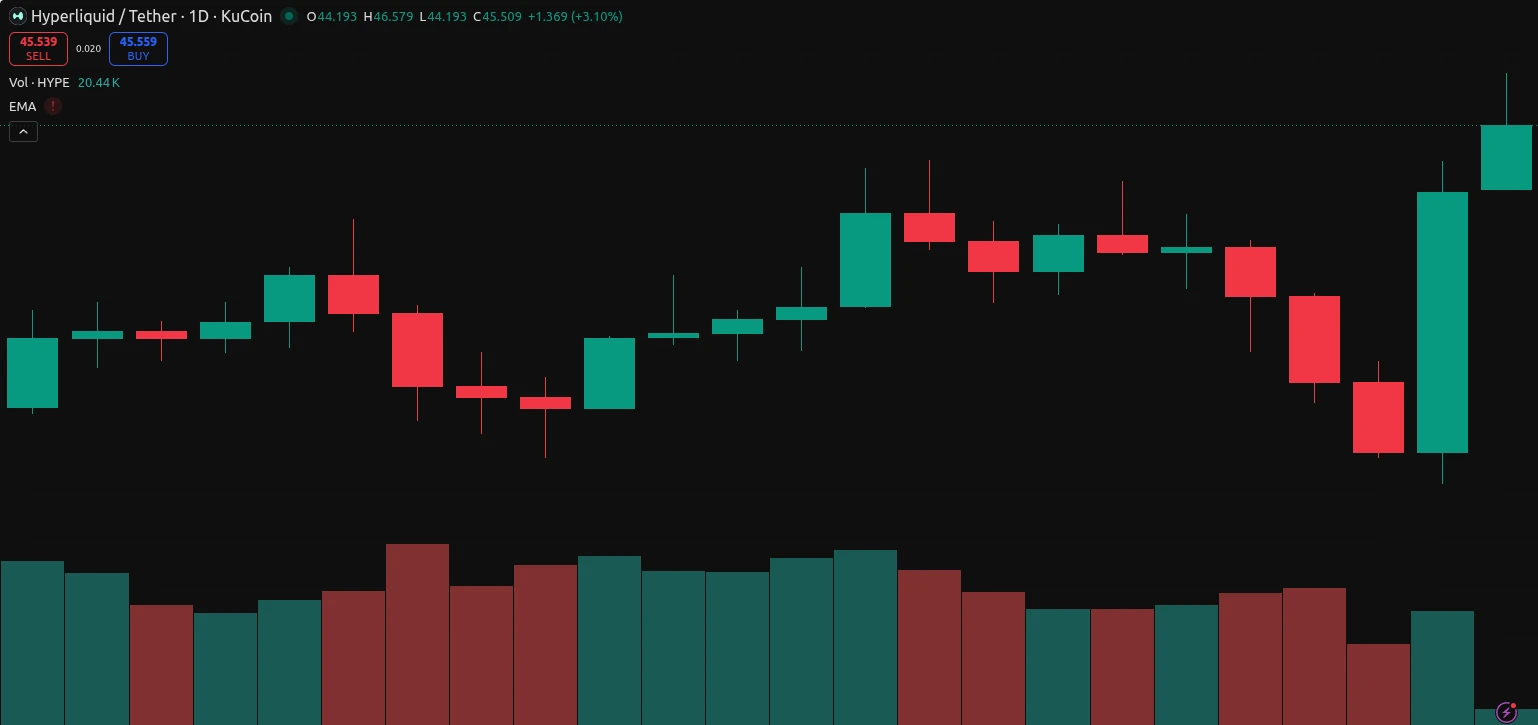
HYPE/USDT daily, KuCoin. Source: TradingView.
What Phantom's Path Shows
Phantom's integration of builder codes effectively turns the wallet into a full-featured perps trading platform, built directly on top of Hyperliquid's HyperCore layer. Users already trusted the wallet for self-custody — the Hyperliquid integration gave them a reason to trade through it.
Builder codes allow Phantom to relay trades to Hyperliquid on its HyperCore layer, letting users open and manage positions without needing to leave the app or interact directly with the Hyperliquid interface. Everything happens within the Phantom wallet.
The lesson here is not that Phantom is a particularly sophisticated financial firm. It is that applications that previously struggled to monetise, particularly wallets and portfolio trackers, now have a direct path to sustainable revenue. No order book. No market-making risk. No custody liability. Product quality plus a builder code equals revenue proportional to the users you bring.
Users can trade 200+ markets in the Phantom app, including crypto, indices, and commodities — all powered by Hyperliquid's infrastructure, all generating fees for Phantom on every fill. Teams are actively building on this infrastructure. Astarter.app, for example, is a clean trading interface designed to fully leverage Hyperliquid’s builder model.
What Still Needs to Scale
The open question is not whether the builder model works — Phantom has settled that. The question is whether builder diversity holds as the ecosystem matures. Dominant wallets with large existing user bases have a structural advantage over niche or newer entrants competing for the same Hyperliquid DAU pool.
Roughly 40% of Hyperliquid's daily active users now trade through third-party frontends — a figure that has held steady, suggesting builders are adding volume rather than cannibalising native users. But the ceiling for that share is unclear. Meanwhile, HIP-4, launched on May 5, 2026, introduces outcome contracts that enable prediction markets — a new contract type that adds variables to the fee mix, and one that builder frontends will need to integrate to remain competitive. The USDC-to-USDH collateral transition adds another structural shift builders will need to navigate.
Key Takeaway
The builder economy is maturing faster than expected. With Phantom accounting for roughly 44% of total cumulative builder revenue, and at least five other teams crossing $1M in lifetime earnings, the ecosystem is not winner-take-all — not yet. The $100M annualized run-rate confirms the distribution layer has become a real business.
By incentivizing 100-plus teams to funnel trades through builder codes, Hyperliquid has effectively outsourced its customer acquisition to an army of third-party apps. Phantom is the clearest proof that strategy works. The April thesis stands validated. Watch whether HIP-4 and the growing institutional layer — 21Shares launched THYP, the first U.S. spot HYPE ETF, on May 12, the same day Phantom's milestone was announced — accelerates or concentrates the builder economy further.