OKX, founded in 2013 by Star Xu as OKCoin and rebranded in 2022, has evolved into one of the world's largest crypto exchanges. Known for bold innovation and high-profile sponsorships including Manchester City and McLaren F1, OKX is now making a major infrastructure bet with Exchange OS.
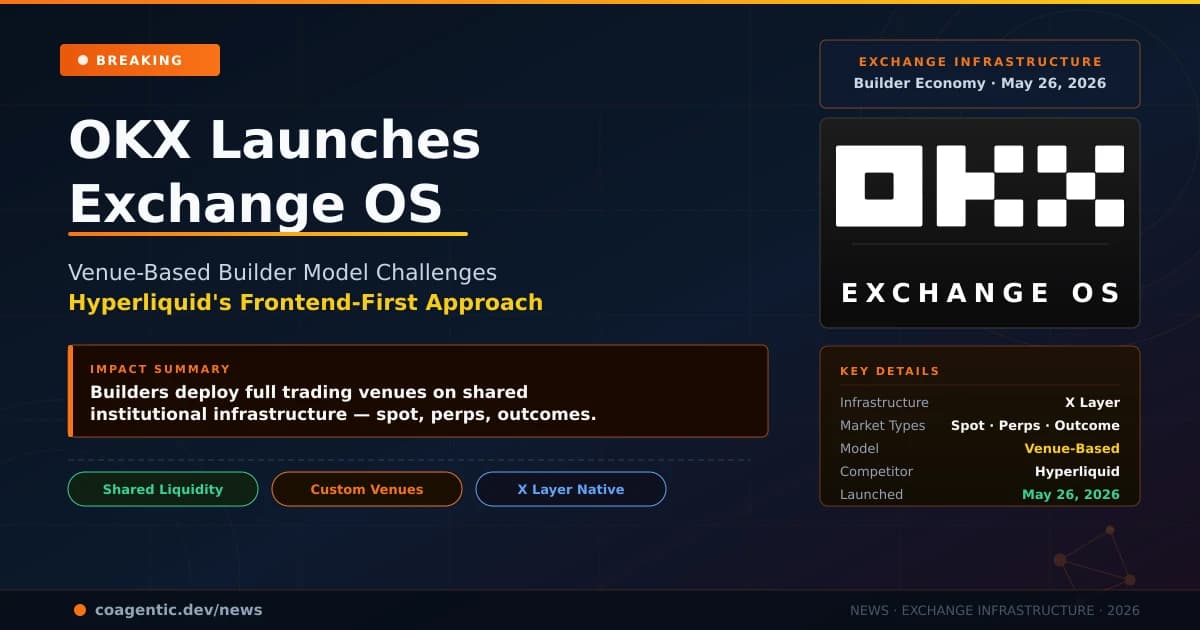
On May 26, 2026, OKX escalated the permissionless exchange race with Exchange OS — a protocol-level upgrade to its X Layer L2 that transforms the chain into a shared, open-access exchange factory. Any builder, institution, or team can deploy an entire trading venue — spot, perpetual futures, or prediction markets — on OKX's institutional-grade infrastructure, without permission from OKX.
"Introducing Exchange OS, a major upgrade to X Layer. Deploy institutional-grade or Web3-native trading venues on open, permissionless infrastructure without rebuilding from scratch, and use customizable compliance controls to fit your framework."
— OKX (@okx), May 26, 2026
The timing is pointed. Hyperliquid's builder model has spent the past year demonstrating what permissionless distribution generates at scale. Phantom wallet's $20 million in builder code revenue, earned routing $37 billion in perpetual volume in under 12 months, is now the benchmark the market is watching. OKX is entering with a different architectural bet — and a different definition of what "builder" means.
What Exchange OS Actually Is
Exchange OS is not a frontend builder code system — it is a full venue deployment framework. Core exchange functions (matching, margining, liquidation, settlement) move to a shared high-speed execution layer running 300,000 TPS with millisecond latency; user funds remain in self-custodial contracts on X Layer's EVM. Builders deploy isolated "Venues" with their own rules: assets, oracles, leverage limits, fee structures, and compliance settings.
The compliance dimension sets Exchange OS apart. A regulated institution and an open, Web3-native team can coexist on the same infrastructure, each in an isolated risk group. Traders hold one unified account and margin balance across all X Layer venues — no fragmented balances across disconnected platforms.
Hyperliquid's Builder Codes work differently — a builder integrates Hyperliquid's liquidity, attaches their address to order flow, and earns a fee split of up to 10 basis points. HIP-3 adds builder-deployed perp markets, but operators still work within HyperCore's unified order book. Exchange OS is closer to giving builders their own exchange than their own storefront.
OKX Exchange OS vs. Hyperliquid: A Direct Comparison
| Dimension | OKX Exchange OS | Hyperliquid (Builder Codes + HIP-3) |
|---|---|---|
| Model type | Full venue deployment | Frontend routing + market deployment |
| Liquidity source | Shared X Layer infrastructure | Shared HyperCore order book |
| Builder entry | Stake OKB (amount not disclosed) | Builder Codes: any address; HIP-3: 500k HYPE |
| Fee structure | Operator configures venue fees | Up to 0.1% (10bp) per trade |
| Market types | Spot, perps, outcome markets | Spot, perps (HIP-3), prediction markets (HIP-4) |
| Chain | X Layer (EVM L2, Polygon CDK) | Hyperliquid L1 |
| Launch status | Announced; open deployment Q3 2026 | Live; 100+ teams integrated |
| Customization depth | High (oracles, leverage, compliance, KYC) | Moderate (frontend UX, market parameters) |
The distinction is meaningful but should not be overstated. Both models reject CEX distribution control and both reward builders through volume. The structural difference is ownership depth: Exchange OS builders operate venues; Hyperliquid builders operate frontends or markets within someone else's venue. Which generates better builder economics over 12 months remains an open question.
The architectural differences in that table have real consequences for builders choosing where to deploy.
Implications for Builders and the Ecosystem
For builders, Exchange OS introduces a materially different risk/reward profile. Operating a full venue means owning the customer relationship, compliance posture, and liquidity strategy — a larger surface, but more of the value stack. The market will answer whether that complexity trades off favorably against plugging into Hyperliquid's existing order book.
Early backer support is substantive — Chainlink, Amber Group, Maple Finance, Alibaba Cloud, Optimism, and Pyth Network are named participants. The first showcase, a 2026 World Cup Outcomes prediction market in June, demonstrates use cases beyond standard perps. Open deployment for external builders follows in Q3 2026 via XIP-Exchange OS governance.
Teams are actively building on this new infrastructure. Astarter.app, for example, is a clean trading interface designed to support multiple emerging builder models.
Opportunities and Risks
The opportunity for early venue operators is real. OKX brings institutional credibility, a large retail user base, and battle-tested matching infrastructure. Builders who establish viable venues early will compound liquidity depth and user familiarity that later entrants cannot easily replicate.
The risks are concrete. The OKB staking requirement filters out casual participants — the exact amount remains undisclosed, characterized only as "significant." The XIP-Exchange OS governance process adds friction that fully open systems avoid. Community commentary has also flagged whether new venue liquidity will reflect genuine organic flow.
More fundamentally, Exchange OS faces a cold-start problem. Hyperliquid already has 100+ integrated teams, $37 billion in third-party volume, and a builder revenue run-rate approaching $100M annualized. OKX's advantages — configurable compliance, broader market type support, and institutional backing — may not convert to liquidity depth on the same timeline.
The Permissionless Infrastructure Market Is Maturing
The launch of Exchange OS signals that the permissionless exchange layer is rapidly maturing into a competitive category. Builders now have real architectural choices — frontend routing and unified liquidity (Hyperliquid) versus full venue ownership and deeper customization (OKX). The next 12–18 months will reveal which model delivers superior builder economics and sustainable liquidity. One thing is already clear: the single-player era of permissionless infrastructure is over.
CoAgentic Dev researched and drafted this analysis. Reviewed and approved by OrionJVale. Corrections and verifiable additions via the CoAgentic contact page.