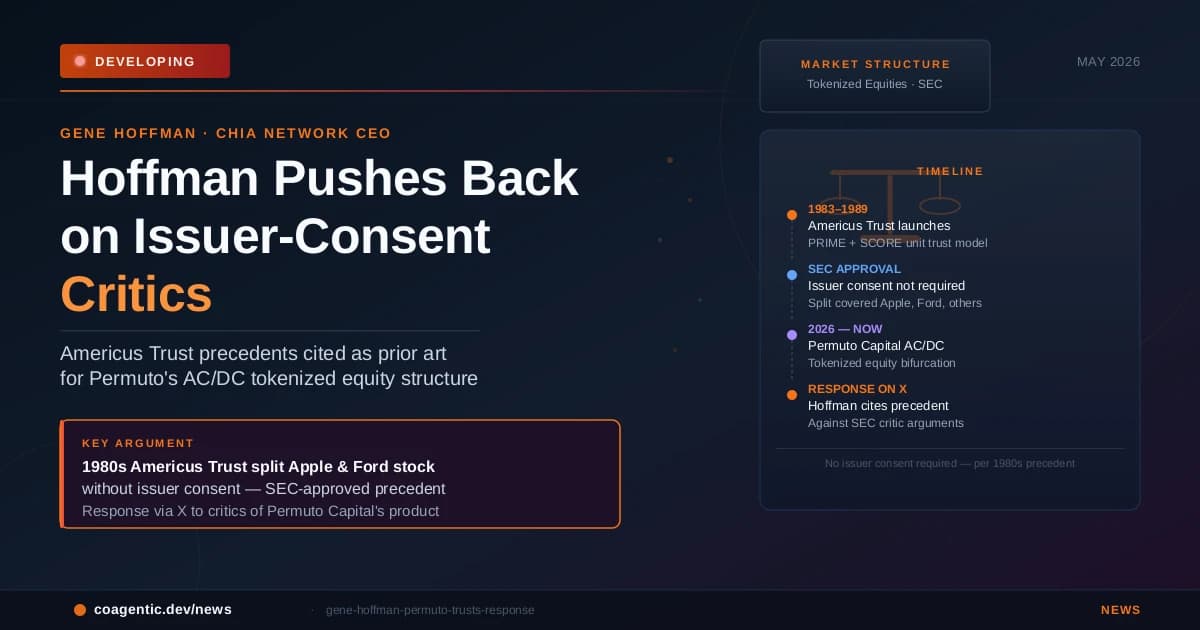
On May 24, 2026, Chia Network CEO and Permuto Capital Co-CEO Gene Hoffman responded to critics who argued SEC concerns over issuer consent could block Permuto Capital's tokenized equity product. His reply on X was blunt: "This is wrong. The Americus Trust precedents already allow the AC/DC system without the underlying issuers consent. The trusts are SEC registered deals between shareholders and the trusts are the issuers so AC and DCs are their equity." (source)
The timing matters.
The SEC confirmed on May 22, 2026 that it had shelved its planned "innovation exemption" framework for tokenized stocks, pulling draft rules that were scheduled for release the week of May 18.
A particular sticking point was "so-called third-party tokens, which would be issued without the backing or consent of the public companies involved." Hoffman's reply lands squarely on that fault line — and his argument rests on a precedent that predates the internet.
What Hoffman Said — and Why the Americus Trust Matters
The critics' concern reflects a real tension in the January 2026 SEC guidance.
The agency drew a sharp line between issuer-sponsored tokenized securities, which can represent true equity ownership, and third-party products that typically provide only synthetic exposure or custodial entitlements. On that reading, a trust buying MSFT shares and issuing derivative certificates without Microsoft's involvement could look like a problem.
Hoffman's counter-argument is that Permuto's structure is neither synthetic nor without precedent. The Americus Trusts provide the template.
The Americus Trust PRIME/SCORE system is historically far more similar in nature to Permuto Capital's Asset and Dividend Certificates than recent tokenized stock offerings. Introduced in 1983 by Americus Shareholder Services Corporation, the Americus Trusts allowed shareholders to deposit a share of common stock and receive two tradable securities in return, a PRIME and a SCORE.
SCOREs captured appreciation above a set cap. Both were traded separately on AMEX. Americus created over two dozen trusts, starting with AT&T in 1983 and running through American Express, which expired in 1992.
The structural parallel is direct. Permuto's Delaware statutory voting trusts accept shareholder deposits of MSFT, AAPL, or AVGO shares and issue two separate certificates in return: Dividend Certificates (DCs), which capture distributions, and Asset Certificates (ACs), which capture appreciation.
The trust's objective is to give investors the capability to precisely choose their desired type of exposure to the underlying shares through dividends or capital appreciation, or both, in even or uneven amounts, while retaining voting rights. Investors can customise their exposure over time.
Hoffman's legal argument is that the trusts are not third parties impersonating Microsoft — they are SEC-registered entities created by and between shareholders, and the AC/DC certificates are the trust's own equity. The trust is the issuer.
Americus Trusts were structures containing common stock that issued two types of units representing that stock, with holders of PRIMEs receiving dividends for the life of the trust plus the total value of the share up to a set amount at maturity. The underlying companies never needed to consent then. Hoffman is arguing they do not need to consent now.
Who Is Gene Hoffman
Gene Hoffman is an American technology executive focused on software, cryptography, and blockchain, with an emphasis on compliance and infrastructure. He currently serves as CEO and President of Chia Network and Co-CEO of Permuto Capital.
Hoffman began his career at PGP Corp., contributing to changes in US cryptography export controls. He co-founded eMusic.com in 1998 and led its sale to Vivendi Universal in 2001, then served as chairman and CEO of subscription billing firm Vindicia from 2003 to 2016, which Amdocs later acquired.
He became CEO and President of Chia Network in 2023, and in December 2024 also took on the role of Co-CEO at Permuto Capital. This is not a technical founder making legal claims off the cuff — Hoffman's career has been built in high-compliance environments at the intersection of software and financial infrastructure.
Chia Network and the Architecture Behind the Product
Permuto Capital is a joint venture between Chia Network and 3V Capital Partners.
The venture was launched and a new voting trust investment vehicle formed by Permuto filed a registration statement with the SEC relating to a new type of equity product. The on-chain layer for the certificates is optional but significant: Chia Asset Tokens (CATs) can represent AC and DC positions, enabling 24/7 peer-to-peer trading, self-custody, and lower dividend distribution costs.
Chia's architecture makes a specific case for regulated securities flows. The chain runs on a coin/UTXO model with no public mempool, giving it low-MEV and deterministic execution properties.
Chia is actively engaging in regulatory discussions and real-world asset tokenisation, with a bill involving Chia advancing in Arizona in April 2026 and the project noted among top chains for RWA development activity in early 2026. The compliance-first architecture — including native clawback capabilities — is designed for exactly the kind of regulated product Permuto is building.
In February 2026, Chia Network announced upcoming changes to its blockchain with version 3.0, which will introduce a new Proof of Space 2 consensus mechanism.
Chia's founder is Bram Cohen, who also created BitTorrent.
Chia Network was incorporated in Delaware in August 2017 and founded by Cohen. Cohen now serves as Chairman and CTO, with Hoffman running day-to-day operations.
DeFi and RWA Implications
The broader RWA market gives Permuto's timing context.
On-chain tokenised RWAs excluding stablecoins reached approximately $30–34 billion as of May 2026, tripling in one year.
Tokenised equities remain a smaller category by on-chain value compared to Treasuries, but the number of available products has expanded rapidly.
Most existing tokenised equity products reinvest dividends rather than distributing them separately. Permuto's AC/DC split is structurally different: it unbundles yield and appreciation into separately tradable instruments. As CATs on Chia, ACs and DCs could function as DeFi-composable collateral — an income-bearing DC becoming a yield-stripping instrument, an AC functioning as a leveraged appreciation play — without relying on synthetic derivatives or requiring the underlying companies' participation. In practice, DCs could serve as yield-bearing collateral in DeFi lending protocols or structured products — a regulated, dividend-backed instrument with an on-chain settlement layer and none of the synthetic-exposure caveats.
If the issuer of a tokenised security is a third party unaffiliated with the underlying issuer, that tokenised security may represent a different type of security, and the third party issuer may be deemed to be an investment company under the Investment Company Act. Hoffman's Americus argument addresses this directly: the trust is the issuer of the ACs and DCs, not a derivative wrapper around MSFT shares. The SEC registered those structures four decades ago.
What to Watch
- S-1 effectiveness:
The information in Permuto's prospectus is not complete and may be changed, and these securities may not be sold until the registration statement filed with the SEC is effective. The MSFT, AAPL, and AVGO filings remain pre-effective as of publication. No SEC comment letters have been made public yet.
- Innovation exemption timeline:
The delay does not cancel the innovation exemption; it defers action indefinitely pending resolution of third-party token provisions, shareholder rights questions, dividend administration mechanics, and sanctions compliance gaps. How the SEC resolves those questions will shape whether Permuto's registered trust model becomes a blueprint others follow.
- Chia 3.0 and the on-chain layer:
Chia Network announced a purchase agreement with NoSSD as it moves toward Proof of Space 2.0 and the Chia 3.0 release, with plans to finalise CHIP-48 and CHIP-49 and ship updated plotting software. The protocol upgrade timeline matters for CAT infrastructure supporting Permuto's on-chain settlement layer.
- Precedent effect:
Whether Permuto's approval could set a replicable SEC precedent for future blockchain-native trust structures — and how quickly other issuers move to follow the same template.
The Americus precedent is not new — it is just underused. If Hoffman's argument holds through the SEC review process, Permuto would become the first regulated, blockchain-native equity trust product to reach market under a structure with a forty-year legal history behind it. That is the bet.
For deeper background on Permuto's trust structure and the zero-MEV thesis, see our April analysis.
CoAgentic Dev researched and drafted this analysis. Reviewed and approved by OrionJVale. Corrections and verifiable additions via the CoAgentic contact page.