On April 28, 2026, Forbes published a piece with a headline that cut straight to it: "How Eric Trump Got Rich From Bitcoin While Losing Investors a Fortune." The article characterised his American Bitcoin (ABTC) mining company as an arbitrage vehicle that enriches its founder while eroding value for retail shareholders — not the low-cost, MAGA-aligned Bitcoin operation it markets itself as. By that evening, Eric Trump was on X calling Forbes a "political weapon" turned into "Chinese propaganda" since its acquisition by a Hong Kong-based ownership group.
The timing was not subtle. Six days earlier, the largest individual investor in the Trump family's other major crypto venture had filed a federal fraud lawsuit against it.
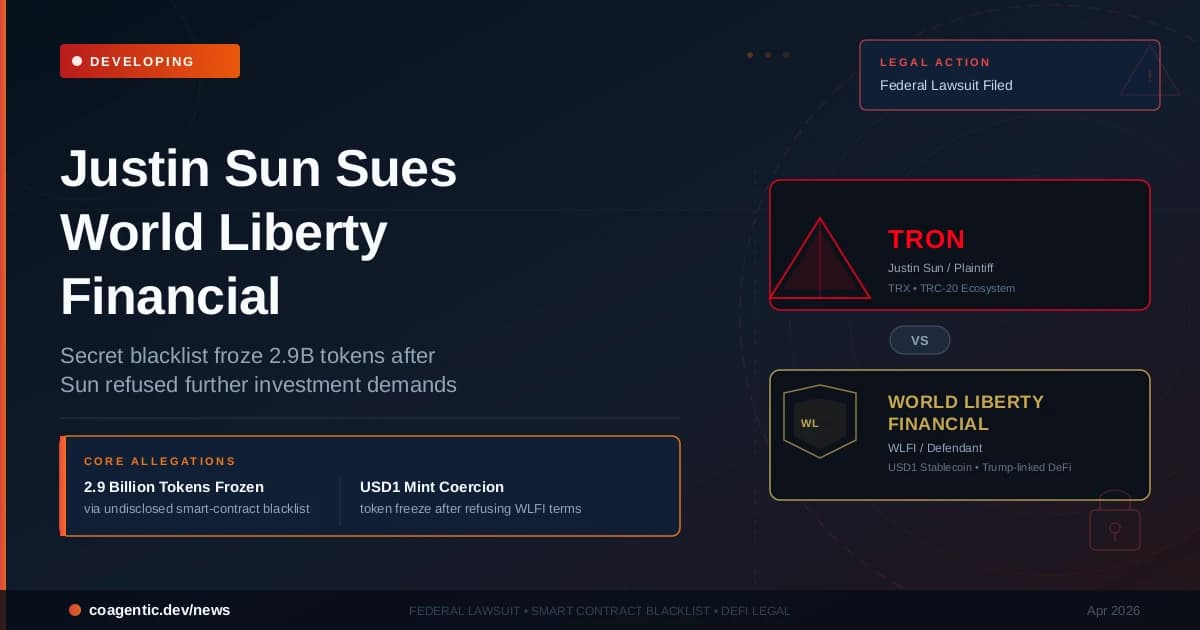
Justin Sun, founder of the Tron blockchain, filed suit against World Liberty Financial (WLFI) on April 22, 2026, alleging breach of contract, fraud, and unlawful seizure of his token holdings. The case marks the most public and damaging falling-out yet for the Trump-linked DeFi project — and it landed in a week where every major thread of the Trump family's crypto operation came under scrutiny at once.
The Forbes Critique — and the Pattern It Fits
The Forbes piece detailed how Eric Trump's personal net worth had grown to roughly $400 million through ABTC and WLFI, while ABTC's retail shareholders saw significant value erosion. Eric pushed back with specifics: ABTC holds more than 7,000 BTC, operates nearly 90,000 miners at 28 EH/s of hashrate capacity, posted $78.3 million in Q4 revenue, and mines at a substantial discount to market price.
But the headline framing — gains for the founder, losses for investors — is precisely what makes the Sun lawsuit land harder. Justin Sun notably keeps a positive, earlier Forbes article about his original WLFI investment pinned at the top of his X profile: a reminder that the same publication once celebrated the deal he now describes as extortion.
This is becoming a pattern. Trump family members increasingly respond to critical coverage of their crypto ventures by challenging the credibility of the source rather than the substance of the reporting. The "Chinese propaganda" label applied to Forbes will not be the last time that framing is deployed.
What Sun Alleges
The lawsuit claims Sun invested $45 million in WLFI in 2024, partly because of the Trump family's association with the project, and that World Liberty later became hostile when he refused to keep investing or mint its USD1 stablecoin on their terms.
Sun — the project's largest individual investor — claims World Liberty Financial used a hidden backdoor blacklisting function in its smart contracts to lock approximately 2.9 billion WLFI tokens belonging to him.
WLFI froze 540 million of Sun's unlocked tokens and 2.4 billion locked tokens — holdings that dropped from over $107 million at the September 2025 freeze to an estimated $43–75 million by April 2026.
In August 2025, WLFI secretly modified its smart contract to add a blacklist function allowing the team to freeze any wallet, transfer tokens, or destroy them — without a governance vote or public announcement. Sun had invested approximately $45 million in WLFI: $30 million in November 2024 and $15 million in January 2025, plus a one-billion-token bonus for his advisory role.
The freeze occurred in September 2025, when WLFI used an embedded smart contract blacklist function to lock Sun's wallet after he transferred approximately $9 million worth of tokens. Sun says the transfers were routine test deposits.
Between April and July 2025, WLFI leadership had repeatedly asked Sun to mint $200 million worth of USD1 on the Tron blockchain. When Sun declined, the tone shifted significantly.
Sun further alleges World Liberty centralized control over tokens, threatened to burn his holdings, and threatened to report him to U.S. authorities over purported KYC issues, while some details of the dispute remain under seal due to confidentiality provisions.
Sun also alleged that World Liberty Financial secretly changed contractual rules governing when owners of its tokens could sell their holdings, giving the company "blacklisting power" over who could transfer the tokens. "There was no governance proposal (let alone a vote of token holders) on whether World Liberty should have this power, nor did World Liberty announce to token holders what the company was doing. World Liberty simply took the power for itself," the complaint alleged.
The Governance Dispute — and the April 15 Proposal
The lawsuit lands in the middle of a broader governance fight.
World Liberty Financial had proposed unlocking 62.3 billion WLFI governance tokens that were previously locked without a vesting schedule.
Under the plan, early supporters holding 17 billion WLFI would keep all their tokens, subject to a two-year cliff followed by a two-year linear vesting period. Founders, team members, advisors, and partners would see 10% of their 45.2 billion WLFI allocation burned, while the remaining 40.7 billion tokens begin unlocking over five years after a two-year cliff.
Because World Liberty froze Sun's holdings in September, he cannot vote his early investor tokens for or against the proposal at all. "This proposal is bad for the community," Sun wrote, "but because World Liberty has frozen my early investor tokens, I cannot vote them for or against the proposal."
Sun labelled the proposal "World Tyranny, Not World Liberty Financial" — a "sham vote" amounting to coercion rather than governance.
The structural design of the vote reinforces that characterisation. Voting yes leads to an extended unlock schedule. Voting no — or simply not voting — leaves tokens permanently locked with no exit path. On-chain analysis shows real contract control rests with an anonymous 3-of-5 multisig and a single guardian externally-owned account that retains blacklist rights regardless of how token holders vote. Participating in the vote at all requires full KYC, which concentrates identifiable holders while leaving the admin controls anonymous.
Sun alleges WLFI excluded him from governance activities, and that the blacklist function enabling the freeze was never disclosed to investors.
Sun's lawsuit
seeks a court order to unfreeze his holdings, trial-determined damages, and an injunction barring WLFI from burning or otherwise tampering with his tokens.
WLFI and Eric Trump Respond
WLFI co-founder Zach Witkoff wrote that "Justin Sun's recent lawsuit against [World Liberty Financial] is a desperate attempt to deflect attention from Sun's own misconduct," adding that "he engaged in misconduct that required World Liberty to take action to protect itself and its users."
World Liberty pushed back publicly, accusing Sun of breaching his investor agreement and "playing victim" while making baseless claims. The team says it froze the wallet as a security measure triggered by suspicious transfers, not as a secret power grab.
Eric Trump was more direct.
"The only thing more ridiculous than this lawsuit is spending $6 million on a banana duct-taped to a wall. We are incredibly proud of the [World Liberty Financial] team," Eric Trump wrote on social media, referring to Sun's 2024 purchase of the art piece "Comedian."
The combative tone is consistent with Eric Trump's broader posture toward WLFI's critics. In March 2026 he called banks "anti-American" for opposing stablecoin legislation — a fight WLFI has a direct financial stake in through its USD1 stablecoin.
Sun, for his part, was careful to frame the dispute narrowly.
Sun was careful to separate the lawsuit from his political support, writing on X that the lawsuit targets "certain individuals on the World Liberty project team," not President Trump or his administration.
The Token's Market Position
WLFI, the native token of the Donald Trump–backed crypto platform, cratered to an all-time low as investors digested news reports of the company's governance controversies. As of midday on April 10, WLFI was trading at $0.08, a roughly 82% drop from its all-time high last September when it traded at $0.46.
The complaint also alleges World Liberty borrowed at least $75 million in stablecoins by pledging billions of its own WLFI tokens as collateral, then converted a portion of those funds into cash.
After CoinDesk first reported on the Dolomite loans, WLFI's price tumbled nearly 15%.
The market risk extends beyond the governance token. USD1, WLFI's stablecoin, has grown to approximately $5.4 billion in circulating supply — but roughly 87% of that, around $4.7 billion, is concentrated with Binance and its users, a consequence of the $2 billion Abu Dhabi MGX settlement, trading pairs, and collateral conversions. A sustained governance crisis or sustained loss of confidence in WLFI could trigger USD1 redemption pressure that lands directly on Binance's balance sheet — a concentration risk that echoes past stablecoin stress events with potential systemic consequences.
The Wider Conflict-of-Interest Picture
The Sun dispute is the sharpest governance flashpoint yet, but WLFI's conflict-of-interest exposure stretches much further.
An investment firm tied to the United Arab Emirates acquired nearly half of the Trump family's cryptocurrency company — a $500 million stake — four days before President Donald Trump's second inauguration, according to The Wall Street Journal. The deal, signed by Eric Trump, gave the Emirati-backed firm a 49% stake in World Liberty Financial.
The Journal cited sources and company documents showing the buyers — lieutenants of Sheikh Tahnoon bin Zayed Al Nahyan, a UAE royal and the country's national security adviser — paid up front, with $187 million going to Trump family entities and at least $31 million going to Witkoff family entities.
Months after Tahnoon purchased the $500 million stake, the U.S. agreed to give the UAE access to 500,000 of America's most advanced AI chips per year.
Legal experts have described the UAE deal as a potential violation of the emoluments clause of the U.S. Constitution.
House investigators probed World Liberty Financial over the reported secret deal, which gave an Abu Dhabi-connected entity a 49% stake shortly before Trump's return to office.
Rep. Ro Khanna demanded detailed ownership, payment, and governance records, including whether $187 million went to Trump family entities and how an Emirati vehicle, Aryam Investment 1, was involved. The inquiry also centres on World Liberty's USD1 stablecoin and its role in a $2 billion Binance investment, as well as any company involvement in discussions preceding Trump's later pardon of Binance founder Changpeng Zhao.
Separately, WLFI faced scrutiny in April 2026 over a partner's prior links to a sanctioned network — adding another layer of regulatory exposure to a project already operating under an unusual degree of political and legal pressure.
Eric Trump's Crypto Wealth
The Sun lawsuit puts Eric Trump's financial stake in WLFI back under scrutiny.
Forbes estimates that Eric Trump is now worth about $400 million, a dramatic jump from his wealth before Donald Trump's return to political power. The biggest reason is his stake in American Bitcoin, a fast-growing crypto mining company.
According to Forbes estimates, Eric gained about $80 million in cash after taxes from WLFI token sales. He holds $36 million worth of WLFI tokens and $19 million linked to the stablecoin business — in total, WLF has added roughly $135 million to Eric's fortune.
The Trump family receives 75% of net proceeds when WLFI sells tokens, as well as a cut of stablecoin profits. By December 2025, the Trumps had profited $1 billion on proceeds, while holding $3 billion worth of unsold tokens.
Sun's Own Legal Context
Sun settled separate SEC fraud charges in March 2026, paying a $10 million fine with no admission of wrongdoing.
In February 2025, shortly after Trump took office for the second time, the SEC was reported to be backing off an investigation it was conducting into Sun's companies. The financial relationship between Trump and Sun raised potential conflicts of interest at that time.
On April 23, 2026 — the same week Sun filed his WLFI lawsuit — Tether confirmed it had frozen $344 million in USDT across two Tron wallets in coordination with OFAC and U.S. law enforcement. The wallets, holding roughly $213 million and $131 million respectively, were flagged for suspected sanctions evasion and criminal activity. Tether has not named the wallet operators, and the freeze is not attributed to Sun.
Why This Goes Beyond One Investor's Dispute
The core question this lawsuit raises is not who is legally right. It is whether a governance token that can be frozen by a centralized admin function was ever meaningfully decentralized to begin with — and what that means for every other WLFI holder.
The allegations, if proven, would indicate that WLFI's governance token design gives its founding team veto power over any holder's economic rights — a structural reality that extends well beyond Sun's individual dispute.
That structural question applies to any DeFi project that markets governance rights while retaining admin-level contract controls. When the team behind the project is also connected to the sitting U.S. president, the regulatory and political stakes compound quickly.
As we noted in our earlier WLFI analysis, the geopolitical layer — a Trump-family U.S. project squaring off against Chinese-born Sun and Tron — adds regulatory and reputational complexity rarely seen in pure DeFi failures. Eric Trump's "Chinese propaganda" label for Forbes only sharpens that overlay.
The company has been the subject of extensive reporting on conflict of interest stemming from Donald Trump's involvement, including secret deals with foreign entities and businesspeople who had previously been under criminal investigation or convicted.
What to Watch
The lawsuit was filed on April 22 in the U.S. District Court for the Northern District of California. Several chunks of the complaint remain under seal. Key developments to monitor:
- WLFI's formal legal response to Sun's complaint in California federal court
- The April 15 governance proposal vote outcome — whether it passes despite Sun being blocked from voting
- Further disclosures on the blacklist function — who else has been or could be affected
- Congressional follow-through on the Khanna inquiry into the UAE deal
- USD1 regulatory scrutiny, particularly given its role in the Binance investment and the pending GENIUS Act stablecoin legislation
- USD1 redemption flows and Binance reserve disclosures — the 87% concentration makes any governance shock a potential stablecoin event
The Sun lawsuit is unlikely to be the last governance challenge WLFI faces. With WLFI trading near all-time lows, a $500 million UAE stake under congressional investigation, a stablecoin dangerously concentrated on a single exchange, and a sitting U.S. president's name on the tin, the project carries more governance exposure than almost any DeFi token in history.
The smart-contract blacklist at the centre of this case is a detail — but it is the kind of detail that tells you something real about how a project is actually structured versus how it is marketed. And what began as a Forbes article about one Trump son's Bitcoin venture is now a thread that pulls on frozen tokens, governance traps, foreign sovereign deals, and a stablecoin that has quietly become too big to ignore.