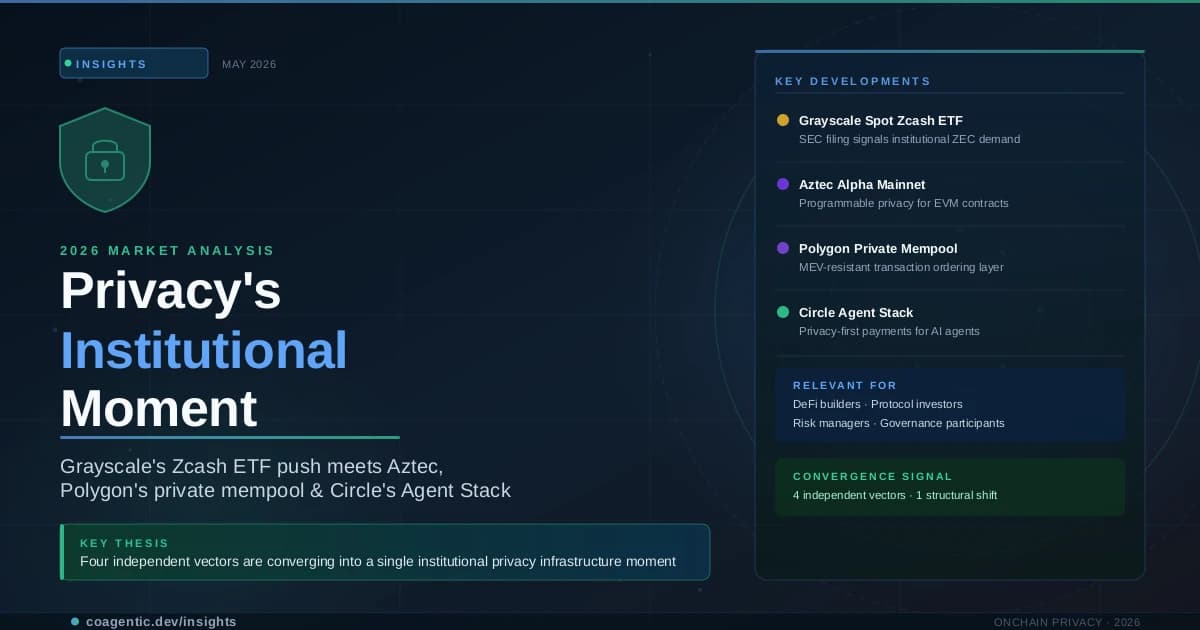
The Convergence Nobody Saw Coming
In November 2025, Grayscale filed to convert its Zcash Trust into what would be the first spot privacy coin ETF in the United States. The firm filed an S-3 registration statement with the U.S. Securities and Exchange Commission, seeking to convert its existing Zcash Trust into a spot ETF. As of May 2026, no SEC decision has been issued — but the filing triggered a cascade that is still accelerating.
ZEC surged nearly 30% to $543 in early May 2026, extending its 30-day gain to more than 110%, following Multicoin Capital's disclosure that it had been accumulating a large Zcash position — arguing that ZEC's shielded transactions offer protection against growing government efforts to scrutinize and tax visible crypto holdings. Roughly 30% of all circulating ZEC, or about 5 million coins out of 16.7 million, now sits in shielded addresses, up from 8% in early 2024.
Meanwhile, four other events landed in rapid succession. Aztec's Alpha Mainnet launched on March 31, 2026, with approximately 6-second block times and a growing TVL of around $1.2 billion. On April 2, Polygon launched a Private Mempool — a private transaction submission endpoint that protects every transaction from frontrunning and sandwich attacks, requiring nothing more than a single RPC URL swap to activate. And on May 11, 2026, Circle Internet Group announced the launch of Circle Agent Stack, a new set of services and tools designed for the agentic economy, with initial products including Agent Wallets, Agent Marketplace, and Nanopayments powered by Circle Gateway.
Privacy is arriving from multiple directions simultaneously. This is not a narrative — it is infrastructure.
Why Privacy Matters Now
For most of DeFi's history, the transparency argument ran one way: public blockchains are trustworthy because everything is visible. In 2026, that argument is breaking down under three separate pressures.
MEV and sandwich attacks. Polygon's Private Mempool launch targets a long-standing issue across blockchains, where bots monitor pending transactions and extract value before confirmation, often leaving users with worse pricing or failed execution. Polymarket users, for instance, had been subject to frontrunning on authorization revocations — the private mempool protects transaction ordering so that submitted transactions cannot be intercepted and reordered before confirmation. MEV is not a theoretical problem: it costs DeFi users measurable value on every significant trade.
Institutional RWA confidentiality. Aztec's privacy pillars address data, identity, and compute — enabling use cases such as private transactions, RWAs, payments, and stablecoins, as well as accounts that privately connect real-world identities onchain for institutional compliance or financial reporting where users selectively disclose information. Institutions cannot place tokenized assets, trade strategies, or client positions on a public ledger. This is a structural adoption blocker that programmable privacy directly removes.
The agentic AI economy. This is the newest and most underappreciated vector. Circle Agent Stack's products help developers and self-running AI agents to build systems where agents can hold assets, discover services, and transact programmatically with USDC across supported blockchains and payment protocols. Nanopayments powered by Circle Gateway enable gas-free USDC transfers as small as $0.000001 at machine-speed and scale, designed for high-frequency, sub-cent, machine-to-machine payment flows. Agents executing millions of micro-transactions at machine speed are uniquely exposed to frontrunning and surveillance — every pending transaction is a target for a faster bot.
Selective disclosure, not full anonymity. The institutional distinction that makes Zcash viable where Monero struggles is the viewing key architecture. The zk-SNARK-led shielded transactions of Zcash deliver an exclusive selective disclosure form — permitting users to effectively maintain confidentiality while permitting regulated transparency at the time of requirement. Compliance auditors can verify activity on demand without requiring public on-chain exposure. That is the design that threads the needle between institutional demands and regulatory requirements.
Zcash and the ETF Catalyst
Grayscale filed an S-3 registration statement with the U.S. SEC to convert its Grayscale Zcash Trust into a spot exchange-traded fund. If approved, the fund would be the first-ever regulated spot ETF for a privacy-preserving crypto, listed on NYSE Arca under the ticker symbol ZCSH.
The filing is the first of its kind — and the path to approval is not straightforward. The SEC has no direct precedent for a spot privacy coin product, and as of May 2026, no decision has been issued. However, the regulatory landscape has shifted meaningfully. The SEC completed a long review in January 2026 with no enforcement action, reducing a major regulatory overhang. That is a different signal than a rejection.
As of March 31, 2026, NYSE Arca received regulatory approval permitting creations and redemptions via in-kind transactions in exchange for ZEC — a meaningful structural step toward full ETF conversion. Coinbase Custody serves as the custodian, with Coinbase itself named as prime broker.
The institutional stack is assembling independently of the ETF outcome. Multicoin Capital has built a "significant position" in Zcash, co-founder and managing partner Tushar Jain said at Consensus Miami, linking the purchase to a view that private stores of value will matter more as finance moves on-chain. The rally followed institutional accumulation disclosures, growing ETF speculation, and increased retail access after a recent Robinhood listing.
The shielded pool data is the most credible signal of genuine adoption rather than speculation. Past ZEC rallies in 2017, 2020, and 2021 all happened with shielded supply percentages in the single digits. The 2026 move is the first time the price is rising while utilisation is also rising. That is a structurally different setup.
Ethereum's Native Privacy Layer
If Zcash is the privacy-native L1 play, Aztec is the Ethereum-native one.
With the infrastructure in place and a unanimous community vote, the network entered Alpha. Alpha is the first Layer 2 with a full execution environment for private smart contracts. All accounts, transactions, and the execution itself can be completely private. Developers can now choose what they want public and what they want to keep private.
The developer ecosystem signal is Noir. Noir has quickly emerged as a developer favourite in the ZK space, boasting over 600 GitHub projects, 900 stars, and 2,000+ VS Code extension installations, with an emphasis on developer experience featuring an intuitive Rust-inspired syntax that makes ZK programming more accessible than ever. In February 2026, the project crossed two milestones — a community-first token sale raising $61 million from 16,700+ participants, and the Noir 1.0 pre-release that makes writing private smart contracts as approachable as writing Rust.
⚠️ Critical risk flag — Aztec v4 vulnerability: On March 17, 2026, the Aztec team discovered a new vulnerability in the network. Following analysis, it was confirmed as a critical vulnerability affecting the proving system as a whole, not mitigated via public re-execution by the committee of validators. Exploitation can lead to severe disruption of the protocol and theft of user funds. Fixes are planned for the "v5" release, currently scheduled for July 2026. Aztec applications and portals bridging assets from Layer 1s should warn users about the security guarantees of Alpha — users should not put in funds they are not willing to lose.
This is an early-stage mainnet with known critical exposure. The v5 patch in July 2026 is the first real stability proof point. Builder enthusiasm is warranted; large fund deposits are not — yet.
On the Ethereum base layer, the censorship-resistance story is advancing separately. FOCIL stands for Fork-Choice Enforced Inclusion Lists (EIP-7805). It randomly selects 17 participants per block slot who can force specific transactions to be included, preventing block builders from censoring valid transactions. It is Ethereum's answer to the censorship concerns that emerged after the Tornado Cash sanctions showed how easily block builders could filter transactions. Developers confirmed that FOCIL, aimed at strengthening censorship resistance, will be included in the Hegota upgrade planned for the second half of 2026.
Vitalik Buterin has highlighted that FOCIL does not work in a vacuum — it is designed to pair with EIP-8141, another proposal scheduled for Hegota. Together, they enable native account abstraction, making smart contract wallets first-class citizens, and privacy protocol support — allowing privacy-preserving transactions to be included rapidly without requiring complex wrappers or third-party intermediaries.
Practical Tools Available Today
These are not roadmap items. They are live.
Polygon Private Mempool (live: April 2, 2026). Transactions submitted through the Private Mempool endpoint go directly to elected producers, bypassing the public mempool entirely. Arbitrage bots have no visibility into pending transactions and therefore no opportunity to act on them. Transactions arrive exactly as submitted and are included in a block without interference. A free tier supports broad adoption, while enterprise tiers offer higher throughput and SLAs. Integration cost: one RPC URL change.
Zcash viewing keys. Selective disclosure without on-chain exposure. A counterparty or regulator with a viewing key can audit a specific address's transaction history in full — without that history ever appearing publicly on-chain. This is the compliance architecture that distinguishes ZEC from protocols where privacy is all-or-nothing.
Circle Agent Stack (live: May 11, 2026). Agent Wallets are permissionless, policy-controlled wallets optimised for agents to hold, send, and manage funds autonomously within predefined guardrails. Agents can sign up and begin using these immediately. Users can create wallets designed for machine-initiated operation and configure controls such as time-bound USDC spending limits and allowlists and blocklists for wallet and contract addresses. Policies are enforced at the wallet layer, allowing transactions to be checked against predefined rules before execution. Available now at agents.circle.com.
As autonomous agents scale — paying for APIs, compute, and data in real time — the demand for private transaction channels compounds. An agent that cannot protect its pending transactions from frontrunning bots is economically exploitable by design.
Risks and Regulatory Outlook
EU AMLR — July 2027 deadline. Under Article 79 of the EU's Anti-Money Laundering Regulation, credit institutions, financial institutions, and crypto-asset service providers are prohibited from maintaining anonymous accounts or handling privacy-preserving digital assets such as Monero and Zcash. These rules are part of Regulation 2024/1624, formally adopted in 2024, set to come into force by July 1, 2027. This restriction applies to regulated exchanges and custodians — not to self-custody or DEX activity. The effect is liquidity fragmentation and exchange delistings across the EU, pushing privacy coin activity toward non-custodial venues.
Importantly, the EU AMLR is what makes Zcash's selective disclosure architecture strategically valuable: the EU AMLR has created a split in the privacy market between native privacy chains and compliance-friendly privacy middleware that provide privacy without breaking regulatory requirements. Selective and programmable privacy has a regulatory compliance argument. Total anonymity does not.
Grayscale ETF — uncertain timeline. The ETF approval is not guaranteed and has no precedent. A Q2-Q3 2026 decision window is plausible given the January 2026 review completion, but the SEC could delay or reject. Investors pricing in ETF approval as a certainty are mispricing the risk.
Aztec v4 vulnerability — v5 patch July 2026. Flagged above. This is a real and present risk for anyone depositing meaningful capital into the Aztec ecosystem before the patch ships and is audited.
The Multicoin paradox. Grayscale has said ZEC's upside is tied to a repricing of financial privacy in an AI-driven world. Multicoin's thesis inverts the regulatory risk: the more intensely governments scrutinise visible on-chain holdings, the more structurally attractive shielded assets become. Regulatory pressure is not a headwind for ZEC — under this framing, it is the tailwind. That thesis is coherent, but it depends on shielded transactions remaining legally permissible in major jurisdictions, which is not guaranteed.
Monero contrast. Monero is the gold standard of cryptocurrency privacy. Every transaction on the Monero blockchain is private by default — sender, receiver, and amount are all hidden using a combination of ring signatures, stealth addresses, and RingCT. That full anonymity without selective disclosure remains a harder compliance case than ZEC. The 2026 privacy trade is bifurcating: selective/programmable privacy (ZEC, Aztec, Railgun) has a credible institutional story; total anonymity (XMR) is increasingly difficult to institutionalise under current regulatory frameworks.
Key Metrics: The 2026 Onchain Privacy Snapshot
| Metric | Data | Source |
|---|---|---|
| ZEC shielded pool (% of supply) | ~30% (up from 8% in early 2024) | CoinDesk Research, May 2026 |
| ZEC price (May 2026) | ~$543–$600 range | CoinDesk, CoinGecko |
| ZEC 30-day return | >110% | CoinGecko |
| Grayscale S-3 filed | November 26, 2025 | SEC EDGAR |
| SEC review completed | January 2026, no enforcement action | Reported by analysts |
| Aztec Alpha mainnet launched | March 31, 2026 | Aztec Network |
| Aztec TVL (Alpha) | ~$1.2B | DEXTools |
| Aztec block time (Alpha) | ~6 seconds | Aztec Network |
| Aztec critical vulnerability discovered | March 17, 2026 | Aztec Network blog |
| Aztec v5 patch (planned) | July 2026 | Aztec Network |
| Aztec TGE participants | 16,700+ ($61M raised) | Aztec Network |
| Noir: GitHub projects / stars | 600+ projects, 900+ stars | Aztec Network |
| Polygon Private Mempool launched | April 2, 2026 | Polygon blog |
| FOCIL (EIP-7805) confirmed for Hegota | February 2026 | Ethereum All Core Devs |
| Hegota upgrade target | H2 2026 | Ethereum developers |
| Circle Agent Stack launched | May 11, 2026 | Circle press release |
| Circle Nanopayments minimum | $0.000001 USDC | Circle |
| EU AMLR privacy coin deadline | July 1, 2027 | EU Regulation 2024/1624 |
What Builders and Investors Should Watch
Grayscale ETF decision (Q2–Q3 2026 window). As of May 2026, the application is pending. Any decision — approval, rejection, or further delay — will be a major price catalyst. The January 2026 no-action review is encouraging context, not a guarantee.
Aztec v5 patch (July 2026). The transition to Beta requires no critical bugs disclosed via bug bounty in three months. The v5 patch shipping cleanly and surviving that three-month window without further critical disclosures would be the first credible mainnet stability signal. Watch this before increasing Aztec ecosystem exposure.
Hegota/FOCIL rollout (H2 2026). Hegota is slated for late 2026, and client teams have begun implementations across both Ethereum's consensus and execution layers, with several having cleared the first two of six milestones. When FOCIL ships, censorship resistance becomes a protocol property of all Ethereum DeFi — not just an Aztec feature.
EU AMLR compliance deadline (July 2027). This is the window for selective-disclosure protocols to demonstrate their compliance credentials to European institutional counterparts. Projects that build audit-compatible privacy infrastructure in this window will be positioned differently from those that do not.
Noir developer adoption trajectory. 600 GitHub projects today. The question is velocity. A doubling to 1,200+ projects by end of 2026 would signal that programmable privacy has moved from specialist infrastructure to general developer tooling.
ZEC shielded pool growth. The move from 8% to 30% shielded supply in two years is the institutional signal that separates this ZEC cycle from prior ones. What traders watch from here is whether the shielded pool keeps expanding alongside the price move. Past ZEC rallies coincided with shielded supply growth that lagged the move, suggesting speculative participation. This rally is happening alongside record-high shielded supply — closer to the on-chain signature of actual adoption. The 30% → 40% threshold would be a meaningful next benchmark.
Circle Agent Stack scale. Circle's Payments Network reported $8.3 billion in annualised transaction volume as of March 31, based on trailing 30-day activity — a head start in terms of the rails agents will have access to from day one. As autonomous agents proliferate, the demand for private transaction channels compounds. Watch developer uptake at agents.circle.com over the coming months.
The Thesis
Privacy is not winning because regulators are backing off. In most major jurisdictions, the opposite is true. Privacy is graduating to institutional infrastructure because a specific kind of privacy — selective, programmable, audit-capable — threads the needle between institutional demands and individual rights in a way that regulators can work with.
The 2026–2027 window compresses four vectors simultaneously: compliant selective privacy (Zcash ETF, viewing keys), programmable private DeFi (Aztec mainnet), base-layer censorship resistance (FOCIL/Hegota), and the autonomous agent economy (Circle Agent Stack). None of these individually makes the privacy thesis. Together, they constitute the first credible institutional privacy infrastructure stack the industry has produced.
The risks are real. An Aztec v5 patch that reveals further instability, a Grayscale ETF rejection, an EU AMLR that forces liquidity fragmentation faster than expected, or an autonomous agent economy that grows faster than the privacy infrastructure serving it — any of these would slow or complicate the thesis.
But the infrastructure is arriving. Privacy band-aids are coming to Ethereum, but it is clear the industry needs privacy now. Privacy is complex — it is not a feature you can bolt on as an afterthought. It demands a ground-up approach, deep tech stack integration, and complete decentralisation. What 2026 is showing is that the ground-up approach has shipped.
The question for builders and investors is not whether privacy infrastructure matters. It is which layer of it to build on — and whether to wait for the v5 patch before doing so.
CoAgentic analysis — human and AI, reviewed and approved by OrionJVale. Corrections and suggestions welcome via the CoAgentic contact page.