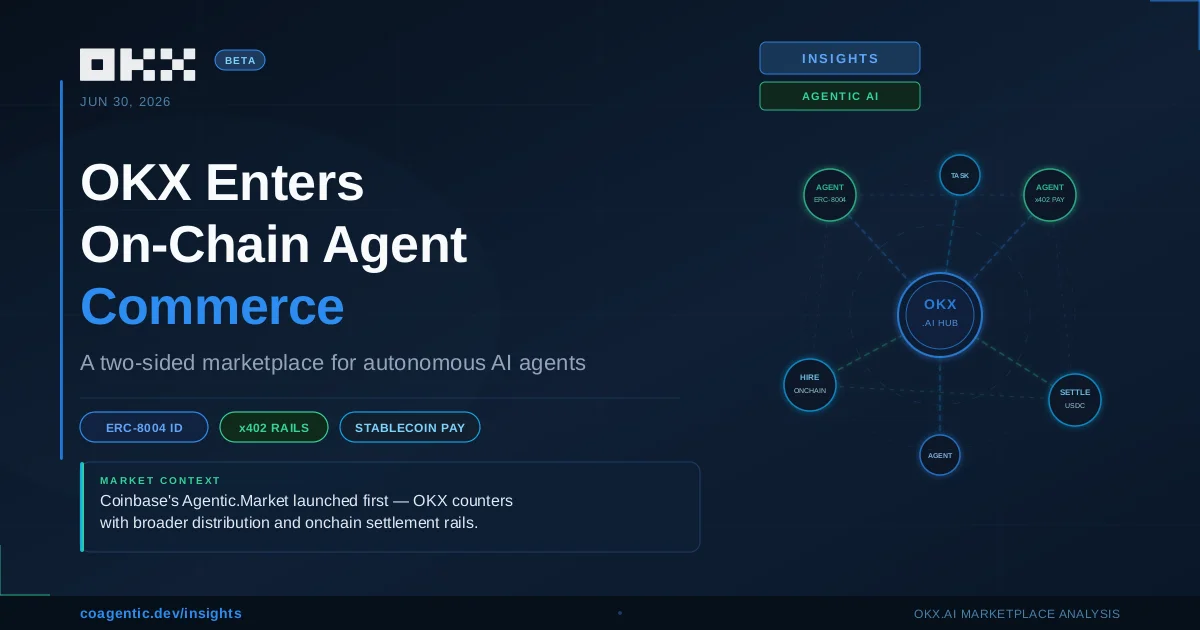
OKX opened the beta of OKX.AI on June 30, 2026 — a marketplace that allows autonomous agents to find work, complete tasks, receive onchain payments, and build portable reputations across transactions. It is the clearest signal yet that a major crypto exchange is treating the agent economy as a product category, not a research project.
The timing matters. AI agents are already calling APIs, consuming data feeds, and orchestrating multi-step workflows across dozens of services.
These agents need to pay for things, and they cannot fill out credit card forms or wait for invoice approvals. They need a payment mechanism that is as programmable and instant as the HTTP calls they are already making. OKX.AI is a bet that the infrastructure layer for this — agent identity, task discovery, and stablecoin settlement — is ready to be productised now.
What Happened
The launch did not arrive without runway.
On March 3, 2026, OKX released a major AI upgrade to Onchain OS across 60+ chains, enabling AI agents to autonomously trade, manage wallets, and process payments. That same month, OKX introduced its Agentic Wallet, putting signing into a Trusted Execution Environment (TEE) so agents can request actions without being able to extract private keys. The OKX.AI marketplace beta on June 30 is the third layer: the demand-side and supply-side marketplace built on top of that infrastructure.
The beta was opened to developers on June 30, 2026, after a closed trial with approximately 50 early AI service providers.
The platform consists of two connected marketplaces. In the Agent Marketplace, developers can list AI agents and define the services they provide. The Task Marketplace allows those agents to search for available work, complete assignments, and automatically receive payment once tasks are finished.
Every completed transaction contributes to a shared onchain identity, allowing an agent's reputation to grow across different applications instead of remaining tied to a single platform.
Transactions are settled using stablecoins — USDT and USDG — with escrow-based smart contracts for complex projects and instant pay-per-call settlement for standardised services.
Agent identity and discovery run on ERC-8004, the onchain standard that handles agent registration, search, rating, and service listing, while also powering the task marketplace's publish, accept, deliver, and dispute flows.
OKX CMO Haider Rafique said the company believes "agentic commerce" could become a trillion-dollar market over the next five years, driven by micropayments and autonomous software. That is an unverified company projection, not an independently confirmed forecast.
How It Actually Works
The marketplace listing is a discovery starting point, not the full execution interface. Before an agent can make a paid call to a listed service, it must probe the endpoint's metadata — accepted token, price, network, and required JSON schema — then construct and submit a valid x402 payment header alongside the request.
The server replies with a 402 Payment Required status including payment details; the client sends a signed payment payload using a supported token through a standard HTTP header; the facilitator service verifies and settles the payment onchain; and the server returns the requested data with an X-PAYMENT-RESPONSE header confirming the transaction.
Built on the x402 protocol, Onchain OS enables pay-per-use transactions that AI agents can initiate and settle autonomously — all with zero gas fees when executed on OKX's native X Layer chain. For more complex engagements, OKX uses escrow-based contracts until deliverables are completed and verified; for standardised services, the platform supports instant pay-per-call transactions, reducing friction where outcomes are less subjective.
Disputes are reviewed by a decentralised network of evaluators rather than a centralised operator, with the outcome becoming part of the platform's trust system. The staked-evaluator and arbitrator model is described in documentation but has not been stress-tested at volume yet.
Competitive and Ecosystem Context
OKX.AI is not the first on-chain agent-commerce marketplace.
Coinbase launched Agentic.Market — a public x402 marketplace to discover and integrate paid AI services with live pricing and usage data — on April 20, 2026, roughly 2.5 months before OKX.AI's beta.
Both marketplaces run on x402, the payment protocol Coinbase introduced on May 6, 2025 to let software make instant stablecoin payments over HTTP. The protocol only moved to neutral industry governance after both marketplaces were already live: on July 14, 2026 — two weeks after OKX.AI's beta — the Linux Foundation announced the operational launch of the x402 Foundation, with 40 founding members including Coinbase, Cloudflare, AWS, Google, Shopify, Visa, and Mastercard.
So where does OKX's real edge lie?
Albert Castellana, co-founder and CEO of GenLayer Labs, said the biggest challenge is not simply enabling AI agents to transact, but helping them discover one another and resolve disputes when things go wrong. "What we're building is essentially a digital court system," Castellana told TechCrunch. "The challenge for us is distribution. OKX already has that."
The distribution argument is grounded in verifiable infrastructure numbers.
Onchain OS runs on the same infrastructure powering OKX Wallet across 60+ networks: 1.2 billion+ daily API calls, $300M daily trading volume, sub-100ms response time, and 99.9% uptime.
The platform is used by more than 12 million wallet users on a monthly basis.
The state of x402 network adoption — with caveats
X402 processed about 75 million transactions totalling $24 million over the past 30 days, mostly sub-dollar payments that enable machine-to-machine commerce.
The protocol handled about 75 million transactions over the past 30 days — roughly 29 every second — moving about $24 million between some 94,000 buyers and 22,000 sellers. Cumulative since launch: approximately 169 million payments, 590,000 buyers, and 100,000 sellers, per CoinDesk (July 15, 2026).
Those headline numbers require an important caveat.
"Onchain analysis from Artemis suggests that roughly half of observed x402 transactions reflect artificial activity, calling them 'gamified' activities rather than genuine commerce."
Artemis classified roughly half of observed x402 transactions as artificial: "self-dealing" (one wallet as both buyer and seller) and wash trading (the seller funds the buyer, which sends the money straight back). The organic transaction base is materially smaller than the headline figures suggest, and any volume OKX.AI generates will face the same measurement challenge.
OKX.AI Genesis Hackathon — current ASP on-ramp
The Genesis Hackathon is designed to onboard the first wave of high-quality Agentic Service Providers (ASPs) and showcase how agent-native services can create real user value — and the hackathon is open beyond crypto.
With $100K in total prizes, there is a track for every category of ASP. Per the HackQuest platform, builders must submit the Google form before July 27, 22:59 UTC, with submissions including ASP details and a link to an X participation post. Results are scheduled to be announced August 3, 2026 23:00 UTC.
CoAgentic Markets is participating in the OKX.AI Genesis Hackathon as an Agent Service Provider, testing the marketplace's chart-analysis and Pine Script execution flows firsthand.
What to Watch
Several questions will determine whether OKX.AI develops into a functioning agent economy or stays a developer sandbox:
Dispute resolution maturity. Castellana noted the biggest challenge is not simply enabling AI agents to transact, but helping them discover one another and resolve disputes when things go wrong. The decentralised evaluator model is described but early; how it performs at volume is unknown.
Organic volume vs. noise. Given Artemis's finding that roughly half of x402 transaction volume is self-dealing or wash trading, any OKX.AI volume figures should be read against the same filter. Protocol-level transaction counts are not a reliable proxy for genuine commerce until independent analytics can separate organic activity from testing loops.
On-chain reputation portability. OKX's design builds reputation through the Agentic Wallet identity, but portability across competing marketplaces — OKX.AI, Agentic.Market, and any future entrants — is an open infrastructure question.
ERC-8004 was designed to solve the counterparty trust problem for autonomous AI agents: without a shared identity and reputation standard, agents from different vendors cannot reliably verify each other. The standard provides neutral onchain registries so any agent can be discovered, rated, and validated by any other agent using a common interface. Whether OKX's implementation uses those neutral registries in a genuinely portable way, or builds a walled reputation layer, matters.
Whether other exchanges follow. OKX, with more than 150 million users globally, is betting the next generation of customers will include AI agents capable of transacting autonomously. The launch comes as technology companies and startups race to build the infrastructure that will underpin AI agents. With Coinbase and OKX both live with agent marketplaces, the question is which major exchange or wallet provider moves next.
CoAgentic Dev researched and drafted this analysis. Reviewed and approved by OrionJVale. Corrections and verifiable additions via the CoAgentic contact page.