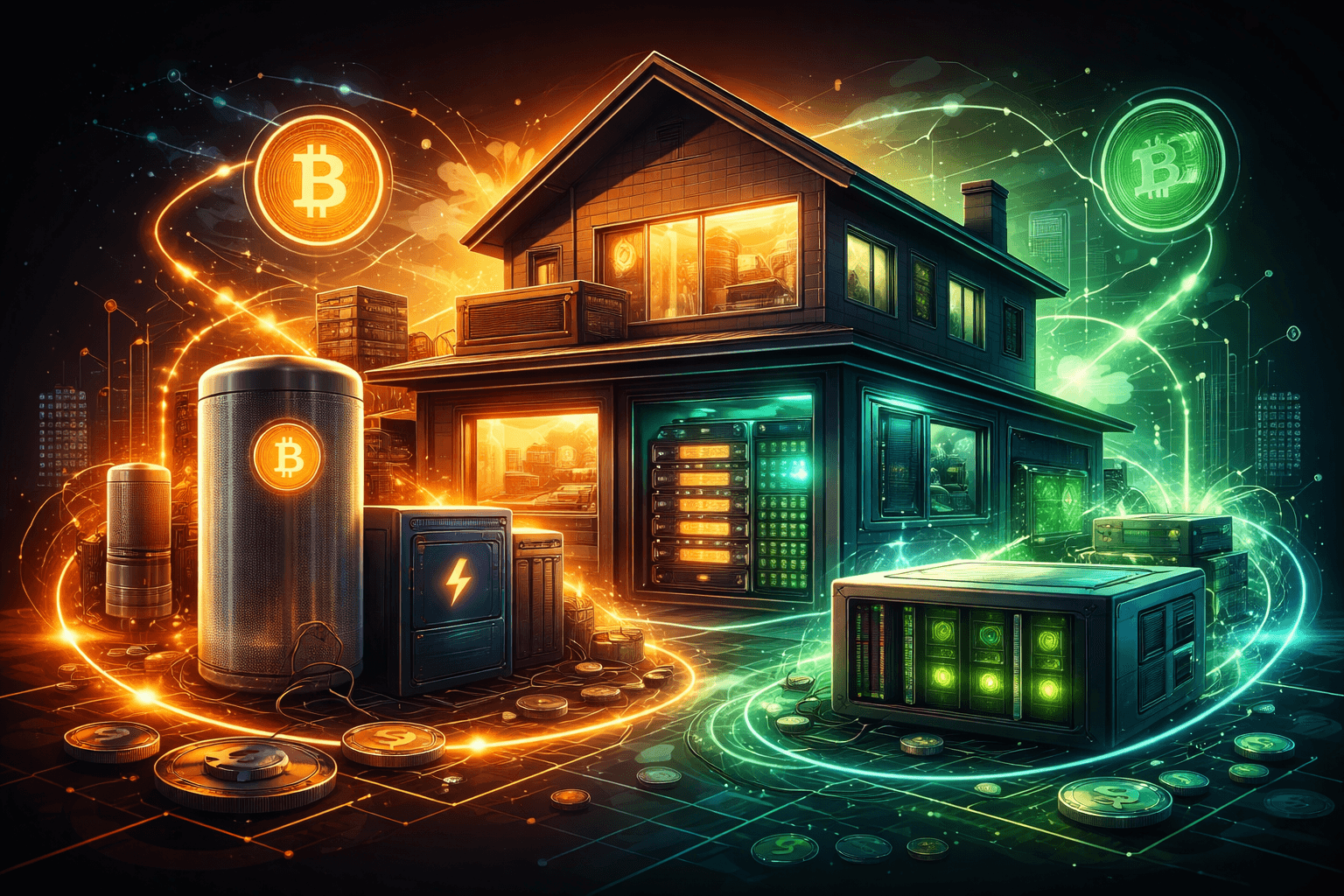
From Boiler to Brain: How Home Mining, Lightning Nodes, Chia Farming & Local AI Turn Houses Into Decentralized Nodes

From Boiler to Brain: How Home Mining, Lightning Nodes, Chia Farming & Local AI Turn Houses Into Decentralized Nodes

Mar 17, 2026

The most interesting shift in crypto infrastructure may be happening at the household level rather than inside another app interface.

Heat-reuse mining hardware, always-on payment rails, idle storage, and local AI each look marginal in isolation. Taken together, they point to a more important idea: the home is starting to look like a modular node that can compute, route, store, and eventually coordinate capital on its own.

The Shift Starts With a Water Heater

Devices such as Superheat’s H1 — a $2,000 50-gallon electric water heater with built-in ~120 TH/s Bitcoin ASICs — replace resistive heating elements with mining chips. The heat byproduct warms your water while the device earns BTC that the company claims can offset up to 80 % of electricity and hot water costs (roughly $1,000 per year under current assumptions). Early shipments are slated for March 2026.

The interesting signal is not the mining yield alone. It is the design direction. Once a device is framed as home-native compute infrastructure rather than a single-purpose miner, the next question is what additional workloads that hardware stack can support over time.

That changes the frame from "one clever appliance" to a possible edge-compute node inside the home.

From Single Device to Home Stack

The bigger shift is not one machine. It is what happens when separate household crypto functions begin to stack together.

A basic home-node architecture is already visible:

  • Compute through mining hardware that converts power into hashpower and useful heat.
  • Storage through Chia farming on underused drives. With Proof of Space 2.0 on the horizon (as explored in our recent insight), farming is becoming even more predictable and home-friendly with minimal power draw.
  • Network participation through a Lightning node routing payments.

Each layer is niche on its own. Together, they start to resemble a modular home system that can earn, route, and store value without depending entirely on centralized infrastructure.

The Missing Layer Is Intelligence

What turns that stack from passive infrastructure into something more dynamic is local AI. Tether’s QVAC platform — an on-device, privacy-first AI system that runs large models without cloud dependency — surged back into focus after CEO Paolo Ardoino teased a major breakthrough just days ago. If model execution increasingly happens on local hardware rather than through a cloud-only API layer, then the home node stops being just a collection of machines and starts becoming an operating environment.

In that model, software agents can monitor liquidity, rebalance positions, coordinate cash management, and execute routine actions without sending every decision through a centralized service. The core implication is not only privacy. It is control over both the compute surface and the keys that govern execution.

What Changes When the Layers Connect

This thesis is not about maximizing one yield source. It is about combining several smaller, independent flows:

  • BTC from compute.
  • Routing fees from Lightning.
  • XCH from storage.
  • Automation from local AI.

A local QVAC agent, for instance, could watch your Lightning node’s liquidity position and automatically rebalance channels using sats freshly mined by your water heater — executing trades or fee optimizations without ever leaving your hardware.

None of these layers dominates on its own. The edge comes from combining them into a single operating stack where different forms of infrastructure reinforce one another.

That is a different model from conventional DeFi optimization, which usually treats capital inside protocols as the only productive surface. Here, the productive surface expands to include the physical environment that supports always-on participation.

Friction Still Matters

The stack is not frictionless.

Mining returns remain cyclical. Lightning nodes require active liquidity management. Storage farming is typically stable but low-yield. Consumer-grade AI infrastructure is still early, and most households do not run these functions from one unified box today.

That matters because convergence is still a direction, not a finished product. The idea is compelling precisely because the pieces already exist, even if the orchestration layer is immature.

Why This Matters for DeFi

For years, DeFi focused on capital efficiency inside protocols. This model points outward instead, toward unused energy, idle storage, and persistent network connectivity as inputs into financial participation.

If that shift continues, the household stops looking like a pure cost center and starts looking like edge infrastructure for decentralized finance.

The strongest version of the thesis is not that every home becomes a profitable mini data center. It is that more of the crypto stack can move closer to users, with local hardware providing compute, settlement access, storage, and machine-assisted coordination in one place.

Bottom Line

The path from boiler to brain is really a path from single-purpose hardware to modular home infrastructure.

Mining, storage, routing, and local AI are still fragmented categories. But the direction is increasingly legible: homes can become decentralized nodes that do more than consume services. They can participate directly in producing, coordinating, and securing them.

Which piece of the home-node stack are you most excited (or skeptical) about — the mining water heater, Lightning routing, Chia plots, or the local AI layer? Drop your thoughts below.