Overview
In a recent post, Vitalik Buterin draws a clean line through a messy topic: not all user incentives are the same, and conflating them has distorted crypto's product culture for years.
His core claim is simple but uncomfortable: incentives are defensible when they compensate for temporary frictions in an immature system. They are corrosive when they manufacture demand that would not exist even if the product were mature."There are many distinct activities that you can refer to as \"incentivizing users\". First of all, paying some of your users with coins that your app gets by charging other users is totally fine: that's just a sustainable economic loop, there is nothing wrong with this. The activity that I think people are thinking about more is, paying all your users while the app is early, with the hope of \"building network effect\" and then making that money back (and much more) later when the app is mature. My general view, if you really have to simplify it and sacrifice some nuances for the sake of brevity, is: Incentives that compensate for unavoidable temporary costs that come from your thing being immature are good. Incentives that bring in totally new classes of users that would not use even a mature version of your thing without those incentives are bad." - Vitalik Buterin
https://x.com/VitalikButerin/status/2021946120180822405?s=20
This distinction forces a reset. It reframes liquidity mining, airdrops, token rebates, and engagement farming not as growth tactics, but as design choices that shape who your users are and what your protocol ultimately becomes.

The Two Kinds of Incentives
Vitalik separates incentivizing users into two fundamentally different activities:
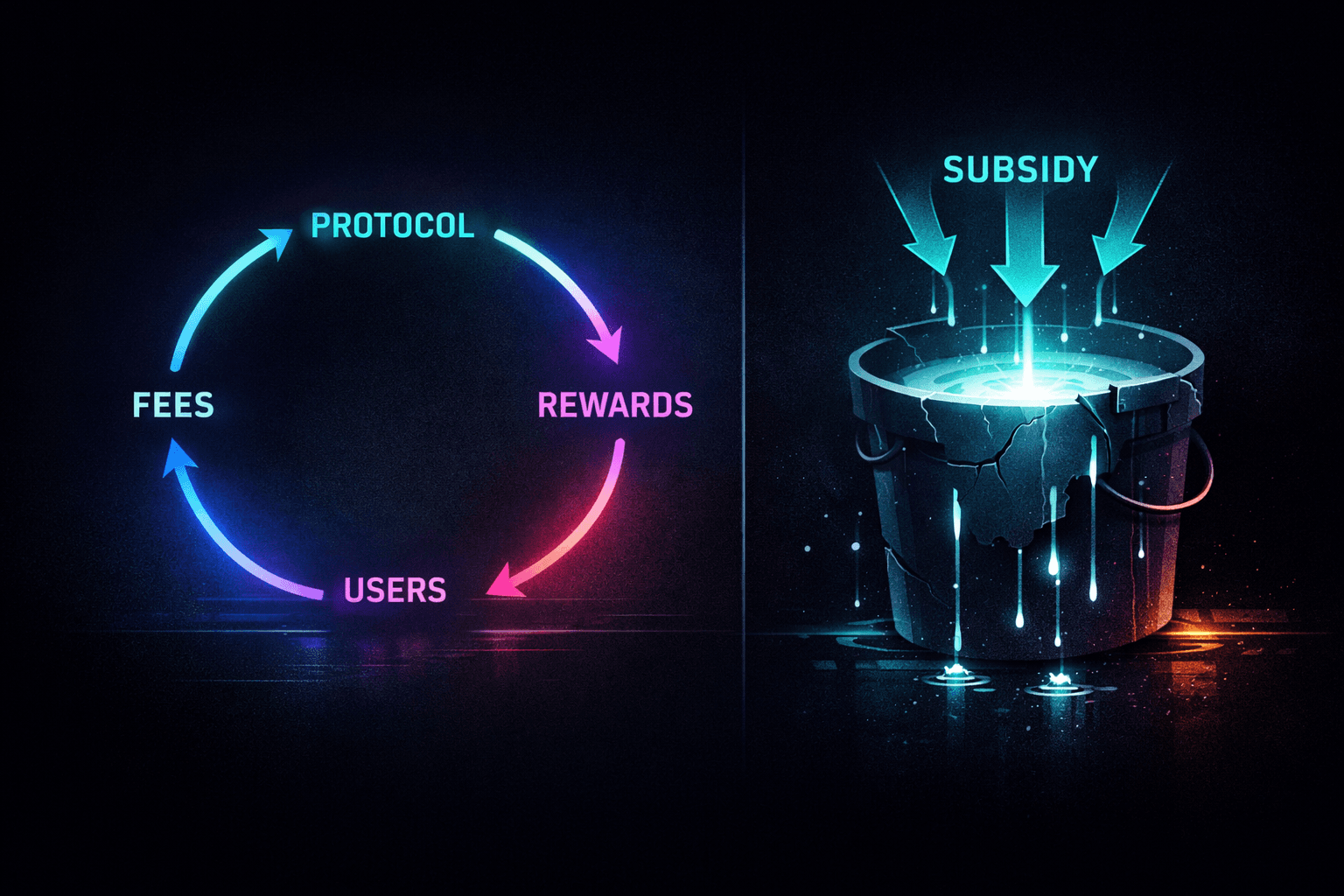
- Redistributing real revenue to users. Paying some users with tokens funded by fees collected from other users is a sustainable economic loop. It is internal to the system. It scales with usage. There is no structural issue here.
- Subsidizing all users early to build network effects. Paying users in the hope that growth today translates into defensible economics tomorrow. This is the classic bootstrapping narrative, often justified as necessary to reach escape velocity.
His simplified rule:
- Incentives that compensate for unavoidable temporary costs of immaturity are good.
- Incentives that attract users who would not use a mature version of the product without payment are bad.
This is not a moral judgment. It is a filter for whether demand is organic or synthetic.
Liquidity Mining as Risk Compensation
DeFi offers a strong example of incentives that can pass this test.
In early-stage protocols, liquidity providers bear:
- Smart contract risk
- Governance risk
- Team execution risk
- Unknown market dynamics
Liquidity rewards can be framed as compensation for that risk premium. As the protocol matures and risks decline, the subsidy should compress.
In that framing, 1 ETH in a pool does useful work regardless of whether it is deposited by a cypherpunk or a mercenary farmer. Capital is capital.
But even here, second-order effects matter. High-quality participants do not just provide liquidity. They:
- Write tooling
- Improve docs
- Answer support questions
- Contribute governance signal
- Potentially become contributors or core devs
A protocol that over-optimizes for mercenary capital may get TVL but forgo durable ecosystem depth.
Where Incentives Break: Synthetic Community
The failure mode is clearest in content or social incentives.
Paying users to tweet, post, or generate engagement tends to:
- Optimize for volume over quality
- Incentivize gaming of ranking mechanisms
- Attract users whose sole objective is extraction
- Collapse once rewards end
Even if users do not disappear immediately, you may scale quantity while degrading quality. And in social systems, quality is the product.
DeFi sometimes escapes this trap because capital is fungible and mechanical. Social protocols do not. Community composition is destiny.
The 2021-2024 Reality: When the Product Was the Bubble
Vitalik offers a more cynical interpretation of the last cycle: for many projects, the real product was the speculative bubble.
Under that model:
- Incentives were not bootstrapping utility.
- They were bootstrapping narrative.
- Narrative justified token appreciation.
- Token appreciation validated the narrative.
Everything else was downstream.
The uncomfortable implication: many growth strategies were post-hoc rationalizations for token distribution events designed to sustain price momentum.
In that environment, the relevant question was not does this build network effects, but is this more plausible than pump and dump wearing a suit?
That framing is harsh, but it forces intellectual honesty.
Closed Loops vs External Subsidies
The clean alternative is what we can call closed-loop economics:
- Users pay fees.
- Fees fund rewards or token value.
- Rewards compensate real risk or usage.
- As maturity increases, subsidies decline naturally.
This is different from external capital being used to create artificial activity that must be continuously fed.
Vitalik also suggests that charging users fees and returning value in protocol tokens can be reasonable, effectively defaulting users into being stakeholders. In theory, this aligns long-term incentives and compresses the user-investor distinction.
The constraint is that the token must correspond to real governance or economic rights. Otherwise, it becomes cosmetic alignment.
What This Means for Builders
If we take Vitalik's framing seriously, it implies:
- You cannot subsidize your way to product-market fit. Incentives can smooth friction. They cannot fabricate demand.
- Your early user base shapes your protocol's long-term trajectory. If you optimize for extractive behavior, you will design for extractive behavior.
- Narrative engineering is no longer enough. In a post-hype environment, usefulness is not optional.
- Subsidies should be temporary by design. If you cannot articulate when and why rewards should decline, they are likely masking structural weakness.
The most respected apps today are not the ones paying the most. They are the ones users would use even without payment.
That is a higher bar.
The Hard Part: Measuring Would They Still Use It?
Vitalik's test hinges on a counterfactual: would this user be here if incentives disappeared?
That is difficult to measure. Some practical signals:
- Retention after reward reductions
- Usage that persists after token unlocks
- Organic referrals independent of airdrop speculation
- Activity patterns that resemble genuine utility rather than farming loops
Without this data, claims of bootstrapping network effects are just stories.
Where the Argument Needs More Precision
A few areas require deeper evidence or clarification:
- Empirical data: What percentage of liquidity or user activity persists after rewards taper? Cross-protocol comparisons would strengthen the case.
- Token rebate models: Under what conditions do fee rebates in tokens create real alignment vs circular valuation?
- Social vs financial protocols: The argument clearly differentiates them, but the boundaries deserve sharper articulation.
- Bear market dynamics: Do closed-loop systems materially outperform subsidy-driven systems in prolonged downturns?
The Core Shift
The takeaway is not that incentives are bad. It is that incentives reveal what you believe your product is.
If rewards compensate risk or early friction, they are infrastructure.
If rewards substitute for demand, they are marketing spend with tokenized optics.
The next cycle, if there is one, will likely reward protocols that internalized this distinction. Those that did not will discover that narrative without utility is fragile capital.